
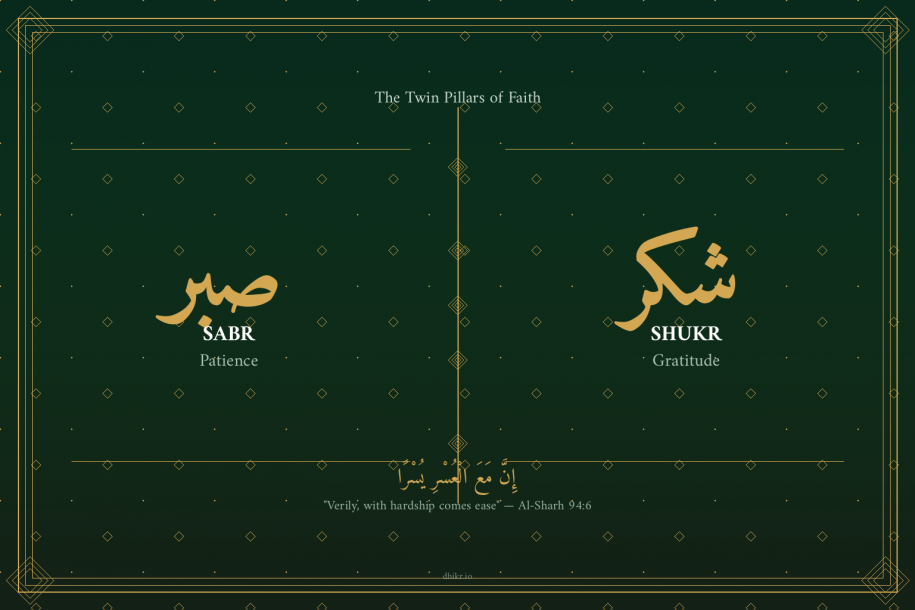
There are two qualities that the Quran returns to again and again — two attributes that Allah pairs together so often that they become inseparable in the life of a believer. Sabr (صبر) and Shukr (شكر). Patience and Gratitude.
They are not just nice virtues to have. They are the architecture of a faithful life. Every moment you experience falls into one of two categories: a blessing that calls for gratitude, or a trial that calls for patience. There is no third option.
As the Prophet ﷺ said:
“How wonderful is the affair of the believer, for his affairs are all good. If something good happens to him, he is thankful for it and that is good for him. If something bad happens to him, he bears it with patience and that is good for him. This is for no one except the believer.”
— Sahih Muslim 2999
صبر — Sabr: The Art of Sacred Patience
Sabr is one of the most misunderstood concepts in Islam. Many people think it means passive endurance — just gritting your teeth and waiting for things to get better. But the Arabic root of صبر carries a much richer meaning: to hold firm, to restrain, to persevere with purpose.
The scholars describe three types of Sabr:
1. Patience in Obedience (صبر على الطاعة)
Staying consistent in worship even when your heart feels heavy. Waking up for Fajr when your bed is warm. Fasting when the days are long. Continuing to give charity when your own wallet feels light. This is the patience of discipline.
2. Patience in Avoiding Sin (صبر عن المعصية)
Holding yourself back from what Allah has prohibited, especially when temptation is strong. In a world designed to pull you toward instant gratification, this form of patience is a daily jihad of the nafs.
3. Patience Through Trials (صبر على البلاء)
The patience most people think of — enduring loss, illness, hardship, and pain without losing faith. Not just surviving the test, but trusting the One who sent it.
Allah mentions Sabr over 90 times in the Quran. Consider that. Ninety reminders that this quality matters. Among the most powerful:
“O you who believe! Seek help through patience and prayer. Indeed, Allah is with the patient.”
— Al-Baqarah 2:153
That phrase — “Allah is with the patient” — is not metaphorical. It is a divine promise of companionship. When you are patient through your darkest moments, you are not alone. The Creator of the heavens and the earth is with you.
“And We will surely test you with something of fear and hunger and a loss of wealth and lives and fruits, but give good tidings to the patient.”
— Al-Baqarah 2:155
Notice: Allah does not say He might test you. He says He will. Tests are guaranteed. The variable is not whether hardship comes — it is how you respond when it does.
The Sabr of Prophet Ayyub (عليه السلام)
If there is one story that defines Sabr, it is the story of Prophet Ayyub. He lost his health, his wealth, his children — everything that a person holds dear. His trial lasted years. Yet through it all, he turned to Allah and said:
“Indeed, adversity has touched me, and You are the Most Merciful of the merciful.”
— Al-Anbiya 21:83
He did not complain. He did not question Allah’s wisdom. He simply stated his condition and affirmed his Lord’s mercy. And Allah restored everything to him — doubled.
That is Sabr. Not the absence of pain, but the presence of faith through pain.
شكر — Shukr: The Power of True Gratitude
If Sabr is how we handle the storms, Shukr is how we handle the sunshine. And it is arguably the harder of the two.
Why? Because gratitude requires awareness. It is easy to be grateful when something obviously good happens — a new job, a recovered illness, a newborn child. But true Shukr is recognising the blessings you have right now that you have stopped noticing.
Your eyesight. Your next breath. Clean water. A beating heart. A roof. The ability to read these words.
Allah makes an extraordinary promise regarding gratitude:
“If you are grateful, I will surely increase you [in favor]; but if you deny, indeed, My punishment is severe.”
— Ibrahim 14:7
This is one of the few places in the Quran where Allah gives a direct, unconditional guarantee. Be grateful, and He will give you more. Not might. Will.
The scholars teach that Shukr operates on three levels:
1. Gratitude of the Heart (شكر القلب)
Recognising internally that every blessing comes from Allah alone. Not from your hard work, not from your intelligence, not from luck — from Him. This is the foundation.
2. Gratitude of the Tongue (شكر اللسان)
Expressing thanks verbally. Saying Alhamdulillah — not as a reflex, but as a conscious acknowledgment. The Prophet ﷺ said: “The best of dhikr is Alhamdulillah” (Tirmidhi). When you say it with presence, it transforms from a word into worship.
3. Gratitude of the Limbs (شكر الجوارح)
Using Allah’s blessings in ways that please Him. You were given wealth? Spend in His cause. You were given knowledge? Teach others. You were given health? Use your body in His worship. This is gratitude in action.
The Shukr of Prophet Sulaiman (عليه السلام)
Prophet Sulaiman was given a kingdom unlike any other — dominion over humans, jinn, the wind, and animals. Yet when the throne of the Queen of Sheba was brought to him in the blink of an eye, he said:
“This is from the favor of my Lord to test me whether I will be grateful or ungrateful. And whoever is grateful — his gratitude is only for [the benefit of] himself. And whoever is ungrateful — then indeed, my Lord is Free of need and Generous.”
— An-Naml 27:40
Even with the greatest kingdom on earth, Sulaiman understood: blessings are a test. Not a reward you earned. A test of whether you will remember the Giver or become intoxicated by the gift.
The Twin Pillars: Why They Always Come Together
Sabr and Shukr are not separate virtues living in isolation. They are two sides of the same coin, and the Quran binds them together repeatedly:
“Indeed in that are signs for everyone patient and grateful.”
— Ibrahim 14:5, Luqman 31:31, Saba 34:19, Ash-Shura 42:33
Four times. The exact same phrase. Patient and grateful. Allah is telling us that the signs in His creation — the lessons, the wisdom, the guidance — are only visible to those who possess both qualities.
Think about it:
- Sabr without Shukr becomes bitterness. You endure, but you forget to appreciate what remains. You survive the storm but cannot see the rainbow.
- Shukr without Sabr becomes fragile. You are grateful when things are good, but you crumble at the first sign of difficulty. Fair-weather faith.
- Sabr AND Shukr together — that is the believer’s superpower. You are anchored in both ease and hardship. Nothing shakes you, because you have found your centre in Allah.
Ibn al-Qayyim, one of Islam’s greatest scholars, beautifully summarised this:
“Faith is in two halves: half is patience, and half is gratitude.”
— Ibn al-Qayyim, Uddat as-Sabirin
Practical Steps: Building Sabr and Shukr Into Your Daily Life
Knowledge without action is a tree without fruit. Here are practical ways to cultivate these twin pillars:
For Sabr:
- Pause before reacting. When something frustrates or hurts you, take a breath. Say “Inna lillahi wa inna ilayhi raji’un” (Indeed, to Allah we belong and to Him we return). This phrase is not only for death — it is for every loss and every trial.
- Make dua in the difficulty, not just after it. The Prophet ﷺ taught us: “Know Allah in prosperity and He will know you in adversity” (Tirmidhi).
- Remember that every trial has an expiry date. “Verily, with hardship comes ease” (94:6). The ease is already packaged with the hardship — it is coming.
- Use the Dhikr app. Track your daily adhkar. Consistency in dhikr builds the spiritual muscle that Sabr requires.
For Shukr:
- Start a gratitude practice at Fajr. Before you check your phone, name three blessings. Say Alhamdulillah for each one with intention.
- Count your blessings when you feel low. This is not toxic positivity — it is Quranic medicine. Allah Himself tells us to remember His favors.
- Make sajdah ash-shukr. When something good happens, drop into prostration. The Prophet ﷺ would prostrate in gratitude whenever he received good news.
- Express thanks to people. The Prophet ﷺ said: “He who does not thank people does not thank Allah” (Abu Dawud). Gratitude to creation is part of gratitude to the Creator.
A Final Reflection
We are in a time when patience is countercultural. Everything is instant — instant delivery, instant entertainment, instant answers. And gratitude is equally rare, because we are trained to always want the next thing.
But the believer operates on a different frequency. The believer knows that this dunya is temporary, that every joy and every sorrow is a passage, and that the only thing that endures is your relationship with Allah.
Sabr and Shukr are not just acts of worship. They are a way of seeing. When you develop these twin qualities, you stop being a victim of your circumstances and become a student of your Lord. Every moment becomes meaningful. Every breath becomes worship.
“And whoever is patient and forgives — indeed, that is of the matters [requiring] determination.”
— Ash-Shura 42:43
May Allah make us among the patient and the grateful. May He grant us Sabr in our trials and Shukr in our blessings. And may He count us among those who see His signs in every moment of this fleeting life.
Ameen.