
The Prophet Muhammad ﷺ said: “Whoever believes in Allah and the Last Day, let him speak good or remain silent.”
— Sahih al-Bukhari 6018, Sahih Muslim 47
In just a few words, the Messenger of Allah ﷺ gave us one of the most powerful principles for human conduct: if what you’re about to say isn’t good, don’t say it at all.
We live in an age of constant noise. Social media comments, group chats, arguments that go nowhere — our tongues (and thumbs) are always moving. But Islam teaches us that every single word we utter is recorded, and on the Day of Judgement, we will answer for all of it.
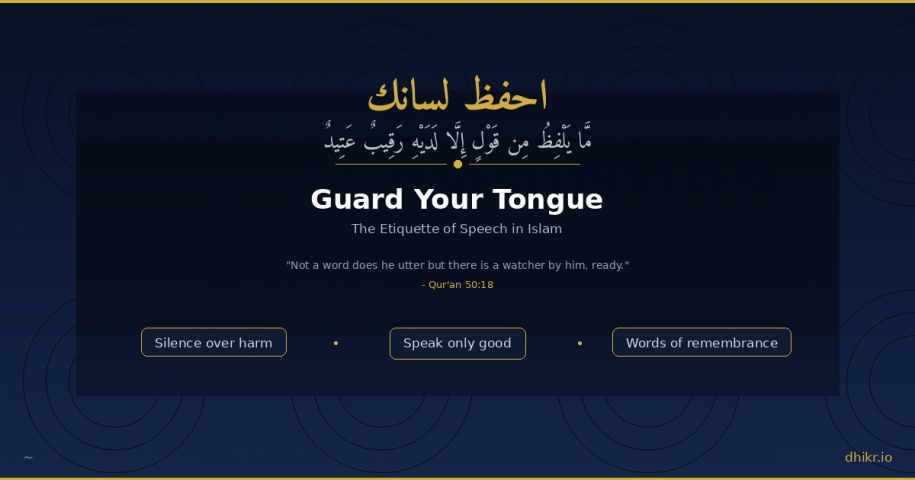
مَّا يَلْفِظُ مِن قَوْلٍ إِلَّا لَدَيْهِ رَقِيبٌ عَتِيدٌ
“Not a word does he utter but there is a watcher by him, ready to record.”
— Qur’an, Surah Qaf 50:18
Let that sink in. Every. Single. Word. The angels are writing. Nothing is missed. Nothing is forgotten.
🤐 The Danger of the Tongue
The tongue is small, but its consequences are enormous. The Prophet ﷺ warned us about its power in no uncertain terms:
“A person may speak a word that pleases Allah, and he does not realise how far it reaches — Allah raises him degrees in status because of it. And a person may speak a word that angers Allah, and he does not realise how far it reaches — Allah throws him into the Hellfire because of it.”
— Sahih al-Bukhari 6478
When Mu’adh ibn Jabal (may Allah be pleased with him) asked the Prophet ﷺ what would cause people to be thrown into the Hellfire on their faces, the answer was chilling:
“Is there anything that throws people into the Fire on their faces — or on their noses — more than the harvest of their tongues?”
— Jami’ at-Tirmidhi 2616
The harvest of the tongue. Everything you’ve ever said — the gossip, the backbiting, the lies, the hurtful jokes, the careless words — it all adds up. It’s a harvest. And the question is: what have you been planting?
🚫 What the Tongue Must Avoid
1. Backbiting (Gheebah)
The Prophet ﷺ defined backbiting clearly: “Mentioning your brother in a way he would dislike.” The Companions asked, “What if what we say is true?” He replied: “If what you say is true, you have backbitten him, and if it is not true, you have slandered him.” (Sahih Muslim 2589)
Allah compares backbiting to something truly horrific:
وَلَا يَغْتَب بَّعْضُكُم بَعْضًا ۚ أَيُحِبُّ أَحَدُكُمْ أَن يَأْكُلَ لَحْمَ أَخِيهِ مَيْتًا فَكَرِهْتُمُوهُ
“And do not backbite one another. Would one of you like to eat the flesh of his dead brother? You would detest it.”
— Qur’an, Surah Al-Hujurat 49:12
2. Foul Language & Swearing
Let’s be real — swearing has become normalised. It’s in our music, our memes, our daily conversation. People think it makes them sound tough or cool. But Islam is clear:
“The believer is not one who curses, swears, or speaks in an obscene or vulgar manner.”
— Jami’ at-Tirmidhi 1977
There is nothing “cool” about foul language. A Muslim’s speech should reflect their character — and a believer’s character is beautiful, clean, and dignified. Every time you choose a clean word over a vulgar one, you’re making a statement about who you are.
3. Lying
“Truthfulness leads to righteousness, and righteousness leads to Paradise. A man keeps speaking the truth until he is recorded with Allah as truthful. And lying leads to wickedness, and wickedness leads to the Hellfire. A man keeps lying until he is recorded with Allah as a liar.”
— Sahih al-Bukhari 6094
4. Gossip & Spreading Rumours
Even if something is true, spreading it for entertainment or to damage someone’s reputation is a sin. The Prophet ﷺ said: “The tale-bearer will not enter Paradise.” (Sahih al-Bukhari 6056)
5. Mocking & Ridiculing Others
يَا أَيُّهَا الَّذِينَ آمَنُوا لَا يَسْخَرْ قَوْمٌ مِّن قَوْمٍ عَسَىٰ أَن يَكُونُوا خَيْرًا مِّنْهُمْ
“O you who believe! Let not a people ridicule another people; perhaps they may be better than them.”
— Qur’an, Surah Al-Hujurat 49:11
That joke at someone’s expense? That sarcastic comment? That meme making fun of someone? Think again. The person you’re mocking might be more beloved to Allah than you are.
💬 What the Tongue Should Do
Islam doesn’t just tell us what to avoid — it shows us how to use our tongues for incredible good:
1. Speak What Is Good
وَقُل لِّعِبَادِي يَقُولُوا الَّتِي هِيَ أَحْسَنُ
“And tell My servants to say that which is best.”
— Qur’an, Surah Al-Isra 17:53
Not just “good enough” — the best. Choose the kindest word, the most gentle phrasing, the most uplifting way to say something.
2. Spread Positivity
The Prophet ﷺ said: “A good word is charity.” (Sahih al-Bukhari 2989)
Think about that. You don’t need money to give sadaqah. A kind word to your mother. An encouraging message to a friend who’s struggling. A compliment to a colleague. Saying “JazakAllahu Khairan” to someone who helped you. Every good word is an act of worship.
3. Remember Allah (Dhikr)
The highest use of the tongue is the remembrance of Allah. SubhanAllah. Alhamdulillah. Allahu Akbar. La ilaha illallah. These words are light on the tongue but heavy on the scales.
“Two words are light on the tongue, heavy on the scales, and beloved to the Most Merciful: SubhanAllahi wa bihamdihi, SubhanAllahil Adheem.”
— Sahih al-Bukhari 6406
4. Enjoin Good & Forbid Evil — With Wisdom
ادْعُ إِلَىٰ سَبِيلِ رَبِّكَ بِالْحِكْمَةِ وَالْمَوْعِظَةِ الْحَسَنَةِ
“Invite to the way of your Lord with wisdom and good instruction.”
— Qur’an, Surah An-Nahl 16:125
When you correct someone, do it with kindness. When you advise, do it with gentleness. The message matters, but how you deliver it matters just as much.
🔑 Practical Tips for Guarding Your Tongue
- The 3-Gate Test: Before speaking, ask — Is it true? Is it necessary? Is it kind? If it doesn’t pass all three, stay silent.
- Replace bad with good: Instead of complaining, say Alhamdulillah. Instead of cursing, say Astaghfirullah. Train your tongue to default to dhikr.
- Avoid gossip circles: If a conversation turns to backbiting, change the subject or leave. Your silence is participation.
- Think before you type: Online words are permanent. That angry reply, that sarcastic tweet — it’s all recorded, both by the internet and by the angels.
- Make morning adhkar your shield: Starting your day with the remembrance of Allah sets the tone for everything that follows — including your speech.
- Apologise quickly: If you’ve said something hurtful, seek forgiveness immediately — from the person and from Allah. Don’t let it pile up.
- Fast your tongue: The Prophet ﷺ said: “Whoever does not give up false speech and acting upon it, Allah has no need of his giving up food and drink.” (Sahih al-Bukhari 1903). Real fasting includes fasting the tongue.
🌟 The Reward of Guarding Your Tongue
The good news? Guarding your tongue is one of the easiest paths to Paradise:
“Whoever guarantees me what is between his jaws and what is between his legs, I guarantee him Paradise.”
— Sahih al-Bukhari 6474
Guard your tongue. Guard your modesty. Paradise is the reward. It’s that simple — and that profound.
Your tongue can be your greatest asset or your greatest liability.
Fill it with dhikr, kindness, and truth — and watch your life transform.
Start your daily dhikr journey with Dhikr.io 📿